
This study undertakes a profound exploration of the mystical teachings of Nahj al-Balagha, attributed to Imam Ali ibn Abi Talib, and their transformative influence on the existential philosophy of Mulla Sadra, the architect of hikmat al-muta’aliya (transcendent philosophy). Through an exhaustive comparative textual analysis, it examines core mystical concepts in Nahj al-Balagha—including tawhid (unity of existence), fana (annihilation of the self), suluk (spiritual journey), and tazkiya (ethical purification)—and their resonance with Mulla Sadra’s metaphysical doctrines, such as harakat al-jawhariyyah (substantial motion), tashkik al-wujud (gradation of existence), nafs al-kamilah (perfect self), and his epistemology of mystical intuition (kashf). Drawing on 34 authoritative sources, encompassing classical Islamic texts, Persian and Arabic scholarly works, and contemporary interpretations by luminaries like Allama Tabataba’i, Ayatollah Javadi Amoli, Seyyed Hossein Nasr, and William Chittick, this study elucidates points of convergence, divergence, and influence. The analysis reveals that Nahj al-Balagha’s mystical insights provided a spiritual and intellectual foundation for Mulla Sadra’s synthesis of rational philosophy, theological doctrine, and mystical intuition, profoundly enriching Islamic metaphysics. This dialogue not only bridges spiritual and philosophical discourses but also offers enduring insights into existential questions of being, selfhood, divine unity, and ethical practice, with significant implications for contemporary philosophical, theological, and interfaith discourse.
Transcendent Philosophy Journal
Mystic Archetypes and Modern Minds: Nietzsche, Jung, and the Dionysian Path to the Übermensch
Dec
This paper investigates the convergence of mysticism, archetypal psychology, and tragic philosophy through a comparative analysis of Friedrich Nietzsche and Carl Gustav Jung. Focusing on Dionysus as a central mythic archetype, it examines how Nietzsche’s notion of ecstatic becoming and existential rupture resonates with Jung’s concept of the mystic archetype, in which ego dissolution facilitates individuation and the attainment of psychic wholeness. Drawing on Nietzsche’s The Birth of Tragedy and Thus Spoke Zarathustra, alongside Jung’s Psychology and Alchemy, the study explores the transformative roles of madness, suffering, and symbolic death in the mystical journey. Two primary questions guide the inquiry: To what extent can mysticism, traditionally framed as a religious phenomenon, be reconceptualized as a universal psychological and existential process? And how do Nietzsche’s Dionysian intensity and Jung’s process of individuation illuminate this contemporary understanding of mysticism? The analysis identifies structural correspondences between these secular perspectives and classical mystical traditions, including Sufism and Christian mysticism, emphasizing shared motifs of ego death, symbolic rebirth, and union with a greater reality. By framing mysticism as a symbolic and psychological architecture rather than exclusively a theological construct, the study positions it as a vital lens for apprehending the human drive toward meaning, integration, and transformation. Ultimately, the paper contends that Nietzsche and Jung reclaim mysticism as a profoundly human endeavour, wherein myth, psyche, and existential insight converge, not in pursuit of religious orthodoxy, but in the quest for authenticity and wholeness in the modern world.
Transcendent Philosophy Journal
From Nihilism to Meaning: “Bridging Viktor Frankl’s Existential Work with Christianity and Sufi Mysticism for Intercultural Dialogue and Geopolitical Peacebuilding.”
Dec
Existential nihilism, marked by a profound crisis of meaning, increasingly characterises contemporary many Western societies. This can manifest as individual despair, social fragmentation, and geopolitical tension. This essay integrates Viktor Frankl’s existential psychology (Logotherapy) with insights from Christianity and Islamic Sufi mysticism, to address nihilism effectively.
I build upon Carl Jung’s symbolic spirituality, Alfred Adler’s community-focused psychology to Frankl’s existential work. I aim to demonstrate how Frankl’s framework uniquely integrates psychological rigour with spiritual meaning. Mystical traditions from Christian and Sufi practices—particularly contemplative prayer and dhikr—can add to Frankl’s existential approach, viewing suffering as transformative rather than meaningless.
The essay centres on a dialogue between Frankl’s existential therapy and the teachings of Sufi thinkers like Rumi and Al-Ghazali. Drawing on my background, I suggest that such existential-spiritual engagement offers vital tools for fostering understanding, social cohesion, and peacebuilding.
Abraham Kuyper’s helpful concept of sphere sovereignty and recent findings on rising Church attendance among young adults in the UK, highlight possible responses to nihilism. I suggest practical pathways for contemporary psychotherapy, interfaith understanding, diplomatic engagement, and community resilience – advocating for talks grounded in shared human experiences of meaning, transcendence, compassion, and unity.
Dec
The essay argues that the philosopher’s task is not abstract speculation but moral navigation — finding an ethical compass that reconciles freedom with responsibility, justice with mercy, and intellect with love. After a broad comparison, the author concludes that the teachings of Seyed Salman Safavi, whose synthesis of Sufi spirituality and philosophical reasoning places mercy, unity, and self-transformation at the heart of moral life, and Søren Kierkegaard, whose insistence on subjective truth, faith, and the courage of possibility restores dignity to the human spirit, together offer the most complete response to the confusion of modern times. The message is clear: philosophy’s true purpose is not to win arguments but to heal the human spirit — to bring order, compassion, and meaning to a world adrift in chaos.
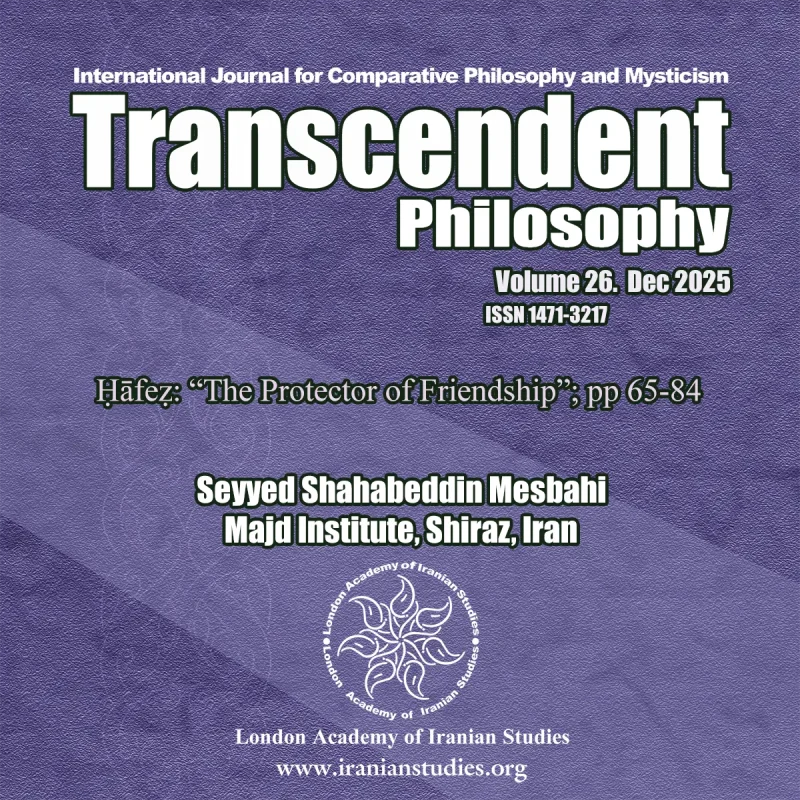
Dec
Introduction The concept of friendship holds a central and methodologically significant role in Ḥāfeẓ’s worldview, serving as a foundational lens for examining its multifaceted dimensions. In my book, I propose an interpretive framework designed to facilitate a comprehensive analysis of this concept, systematically exploring the thematic and conceptual interconnections between the essential terminologies and motifs […]